Posts

Showing posts with the label rootword

Wordwalk Puzzles: 2023-01-27

Image
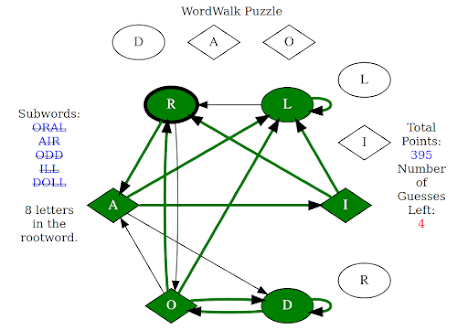
WordWalk Puzzles for 2023-01-28 at https://wordwalk.net Yesterday's puzzles: English rootword was "GRADUALLY". German rootword was "ZWEIFLER". Spanish rootword was "DESCUIDA". Kids rootword was "HUMAN". #wordwalkpuzzles   Here's the solution for yesterday's English puzzle: First subword,  "DRUG":  Second and Third subwords, "DAY" and "LAY": After final subword, "GUY":   Just before placing the final letter of the rootword, "GRADUALLY":       Upon completion:   wordwalk.net  
WordWalk Puzzles: 1/26/23

 WordWalk Puzzles for 2023-01-26 at https://wordwalk.net Yesterday's puzzles: English rootword was "CONDITION". German rootword was "ZUCKTET". Spanish rootword was "MORTALES". Kids rootword was "DEPOSIT". #wordwalkpuzzles

Daily WordWalk Puzzles for 9/24/2022

  Daily WordWalk Puzzles 9/24/2022: English Spanish German Kids Yesterday's words can be found at the website. Enjoy!

Optimal Parameters

Image
The parameters I use in generating the WordWalk puzzles are the following: 1)  The length of the rootword (i.e., the number of letters in the rootword) 2)  The number of subwords to use 3)  The minimum length of each    The goal for setting these parameters is to ensure that the resulting puzzle is not too hard and not too easy. If there are too many subwords, the chances are good that all the letters and all the arrows will already be present in the subwords, thus making the puzzle too hard, because there will be no unused arrows to hint at those used in the rootword.   If the number of subwords is too low, most of the arrows will be used up only by the rootword, making it almost a pure guessing game;  then the game is too hard and not too interesting.   The game is most interesting, I think, when you have to do some logical reasoning by looking at the unused arrows and eliminating some of the possibilities.  The unused arrows prov...

Daily WordWalk Puzzles: 9/14/22

  Daily WordWalk Puzzles: English Spanish German Kids Yesterday's words can be found at the website. Enjoy!

The German Language Can Build Long Words from Few Letters

Image
 One of the subwords is NENNEN, which, as you can see, is formed from just two distinct letters:  N and E.  The rootword is GESESSEN, formed from only three distinct letters. German words are quite capable of being packed into a compact graph!

Changes to Puzzle Rules and Presentation 9/13/2022

Made some changes to WordWalk puzzles: 1) Now displaying number of letters in hidden rootword. 2) The bubble of the rootword's first letter is thickened. 3) The points system has changed (read about it at the site). 4) You get 4 guesses instead of 3 before you lose. 5) Main puzzles are based on 7-letter rootwords and 5 subwords of minimum 3 letters each. 6) Kids puzzles are based on 5-lettr rootwords and 5 subwords of minimum of 2 letters each. Daily WordWalk Puzzles: English: https://wordwalk.net/daily-puzzle-english Spanish: https://wordwalk.net/daily-puzzle-spanish German: https://wordwalk.net/daily-puzzle-german Kids (English): https://wordwalk.net/kids-english-1 Yesterday's words can be found at the website. Enjoy!

Coming Soon: A Change to the WordWalk Points Reward System

Currently, WordWalk starts you off with 0 points and then you get 10 points for each correctly placed subword and an extra 100 for the rootword (which also counts a subword so, in fact, you 110 points for the rootword).  So, for a five-subword puzzle you can get a maximum of 160 points. Moving forward (possibly starting tomorrow) the points system will be different.  You will start out with a certain number of points (say, 100, for discussion purposes).  Then you will get 10 points added to your points stash for each new correctly guessed letter and also 10 points for each new correctly guessed arrow.  These points will not be added, however, until after you've completely and successfully placed the subword in the puzzle graph.  Once that is done you will get some extra points (say, 25) for the subword itself and the new points for new letters and arrows that were obtained while placing the subword. If you fail while trying to place a subword, you won't lose rem...

A New Feature

Image
WordWalk puzzles now highlight the letter that starts the hidden rootword by thickening the border of the shape that depicts it. This was due to discovering that it is easy to forget which letter was first after correctly placing the subwords in the graph. E.g.,in today's English puzzle, we have: The first letter of the rootword is H, as indicated by the ovals with the thick borders.  Then, after embedding, e.g., the subword "HALL" into the puzzle, we can still tell which letter is the first letter of the rootword:

Subwords Can Be Longer than the Rootword!!

Image
Most of the time, subwords are shorter than the rootword, but every once in a while you get a subword that is indeed longer than the rootword. Here's an example in Spanish:  The rootword is "IREMOS", a six-letter word, but one of its subwords, "ERRORES", is a seven-letter word!  The reason for this is that a subword is defined as a word whose set of letters is a subset of the letters in the rootword.  Sets of letters only count each letter once. Thus the set for "ERRORES" is {E,R,O,S}, while the set for "IREMOS" is {I,E,R,M,O,S}.  All the letters of the first set also occur in the second set, and so the former is a subset of the latter.  By definition, this means that "ERRORES" is a subword of "IREMOS".   The word "ERRORES" is long because it uses the letter R three times and the E twice, but doesn't use all the available letters like "IREMOS" does. Here's another example of an 8-letter subwords...